

Blog
The POC Cliff: Why GenAI Pilots Won’t Scale (And the Architecture That Will)
Written By:
Aditya Gollapudi
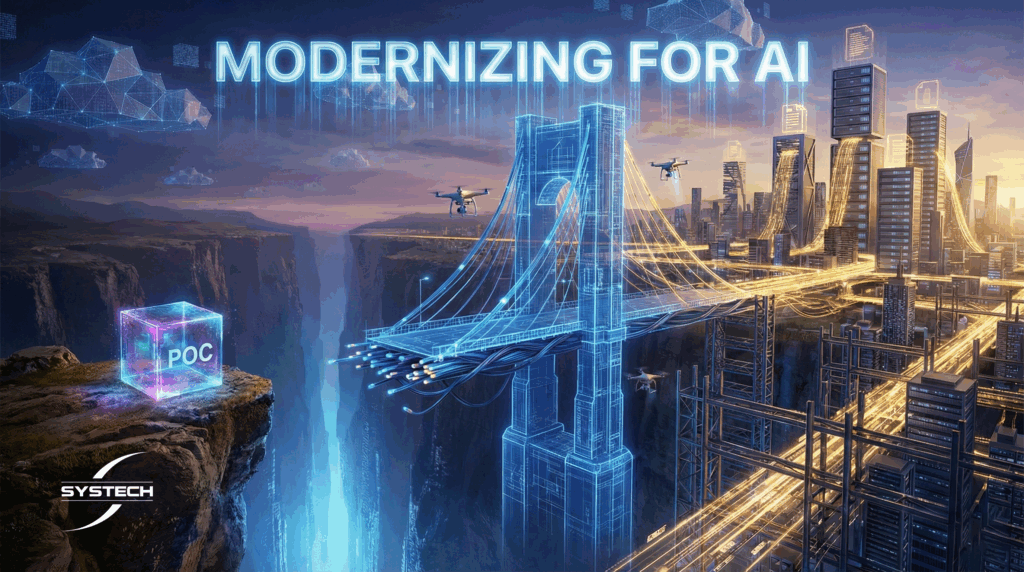
AI is evolving faster than most enterprise architectures can absorb.
Over the last two years, organizations moved from experimenting with chat-based interfaces to building agentic and composite AI workflows that support real decision-making. But despite the hype, many initiatives still stall long before they reach production.
The constraint is no longer model capability – it’s enterprise readiness.
AI succeeds when the foundations are right, and this is where most organizations are feeling the friction.
The Real Blockers Are Architectural, Not Algorithmic
1. Data Readiness – AI amplifies whatever it’s given
Freshness, completeness, lineage, and trustworthiness all directly shape output quality.
It’s not uncommon to see AI initiatives stumble because the data behind them is delayed, inconsistent, or stitched together across legacy systems. Confidence erodes quickly when the answers don’t match lived reality.
The shift in mindset is important here: you don’t modernize all data – you modernize the data that matters for the decisions AI will influence.
2. Performance at Scale – Pilots hide the real challenges
Most proof-of-concepts run in controlled conditions.
They don’t reflect the performance required when hundreds or thousands of users interact with a system simultaneously.
Latency, retrieval patterns, orchestration logic, and caching strategies become architectural priorities. AI moves from being a model to being a system – one that requires redundancy, continuous retraining, and robust monitoring.
3. Cost Transparency – Inference changes the economics
Once AI enters production, inference and retrieval become recurring operational costs.
Teams quickly discover that the architecture must support predictable and sustainable usage patterns, not just experimentation.
Cost optimization becomes inseparable from architectural design – especially when models and data live in different compute planes.
4. Governance – Trust determines adoption
Even when the technology works, scaling AI requires assurance that outputs are:
- Traceable
- Consistent
- Compliant
- Deployed through controlled processes
This is where governance shifts from documentation to automation.
CI/CD pipelines, automated quality checks, and lineage-aware deployments create confidence for both business users and risk teams.
Patterns That Actually Help AI Scale
1. Freshness Over Perfection
The fastest path to value is focusing on the streams that power the highest-impact AI outcomes. Modernization becomes a sequence of targeted wins, not a multi-year overhaul.
2. Bring Compute to the Data
Moving large volumes of data to models isn’t efficient – especially across distributed environments.
Modern platforms like Microsoft Fabric, Snowflake and Databricks make it possible to bring compute closer to data while managing cost and performance more predictably.
This matters even more as enterprises incorporate external and secondary data sources into decision-making.
3. Modernize Without Disruption
Most enterprises cannot pause existing systems while they modernize.
The more pragmatic path is coexistence – running legacy and cloud-native patterns side-by-side while refactoring the highest-impact components first.
We’ve seen organizations adopt bidirectional sync, event-driven ingestion, and phased refactoring to move at speed without breaking operational continuity.
Confidence builds when people can see the new architecture working alongside the old.
4. Embed Governance into Deployment
Governance becomes real when it’s built into the deployment process.
Automated checks, lineage tracking, versioning, and reproducibility make AI systems safer to scale – and significantly reduce time-to-value.
A Pragmatic Path Forward
We’re seeing organizations take a far more practical and measured approach to AI adoption.
One example that reflects this approach comes from a financial institution preparing its data landscape for AI. They had fragmented pipelines, legacy stored procedures, inconsistent data freshness, and increasing pressure to support more intelligent, real-time decisioning.
Rather than pursuing a disruptive overhaul, we started with a structured data discovery phase to understand lineage, dependencies, and the paths that directly influence AI outcomes. That clarity helped prioritize what needed modernization first.
We then introduced a bidirectional sync between their legacy systems and the emerging cloud architecture. This allowed both environments to operate in parallel – business processes stayed intact while the new pipelines, quality rules, and governance controls were built out.
As confidence grew, we refactored the workloads that delivered the highest impact, strengthened performance, and embedded automated governance into the deployment process.
It was a practical, phased modernization that addressed data readiness, performance, cost transparency, and trust – without requiring a big-bang migration.
The Takeaway
AI isn’t failing because models are not capable.
It’s failing because the foundation underneath isn’t ready.
The organizations that will lead in 2026 are the ones modernizing their data architecture, governance, and operating models in parallel – not as afterthoughts. They recognize that AI is no longer a project or a tool; it is a system that learns, updates, and responds – and that system is only as strong as the architecture beneath it.
If you’re assessing your readiness for AI at scale, reach out at https://systechusa.com/contact-us/. Our team would be happy to offer guidance tailored to your landscape.
Related Resources:

Modernize Legacy Data Workloads Faster with DBShift™ + Snowflake — Webinar
Watch how DBShift™ automates legacy-to-Snowflake migration with high accuracy—live demo, architecture, and proven outcomes. Ideal next step after this article.

Unified Data with Snowflake & Systech
See how Systech leverages Snowflake’s power to deliver seamless, scalable data solutions.

Snowflake Partnership: Built for the Future
Explore how our Snowflake partnership empowers GenAI-driven transformation journeys.


