Blog
Written By:
Seethalakshmi Subramanian
For years, modern data teams believed that if you could write SQL, you could build and manage your organization’s transformation pipelines. The rise of cloud data warehouses like Snowflake changed everything — infrastructure vanished, performance became elastic, and the focus shifted to the logic that transformed data into decisions.
In that era of transformation, dbt emerged as a hero. It empowered analysts and engineers to collaborate using SQL and version-controlled workflows. dbt democratized ELT and quickly became the standard for analytics engineering. It built a movement, not just a product.
But something happened as organizations scaled. What worked beautifully for 50 models didn’t work the same for 5,000. What empowered a small team became overwhelming for large, distributed enterprises. Suddenly, dbt projects were filled with growing dependency graphs, layers of Jinja macros, naming conventions, and YAML overhead.
This is the moment the story changes.
Enter Coalesce: A New Approach to Enterprise-Scale Data Transformation
Coalesce wasn’t built to replace dbt. It was built to solve what dbt could no longer handle well at scale.
Coalesce takes a metadata-first, node-based approach. Everything — a stage, a dimension, a fact, an SCD — exists as a node with template-driven logic. Templates enforce structure, reusability, and consistency, eliminating thousands of lines of repetitive SQL. Rather than navigating giant DAGs full of models, you visually build pipelines with reusable components and let Coalesce auto-generate optimized Snowflake SQL underneath.
Where dbt forces you to manage complexity, Coalesce removes it.
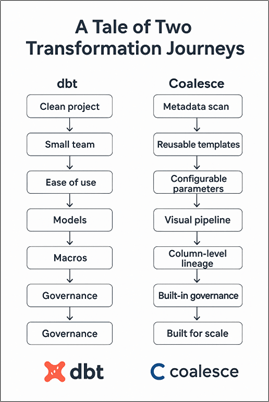
A Tale of Two Transformation Journeys
The dbt Journey
Imagine a data team that begins with a clean project, a small group of analytics engineers, and clear business goals. dbt works beautifully here: everyone commits to Git, writes SQL, maintains models, and publishes documentation.
The Coalesce Journey
Now imagine the same organization beginning transformation in Coalesce.
Templates evolve, platform scales and the complexity stays under control. Where dbt requires more effort as projects grow, Coalesce becomes more valuable with size.
| Capability | dbt | Coalesce |
|---|---|---|
| Core Paradigm | SQL-first | Metadata-first |
| Pipeline Design | Code authored, manually modelled | Visual nodes & template-driven development |
| Reusability | Macros & model duplication managed by developers | Templates enforce reusability centrally |
| Lineage | Table-level; column-impact via add-ons | Column-level lineage; native & UI-based |
| Onboarding | Dependent on project complexity & documentation maturity | Accelerated via template standardization |
| Governance | External policy tooling needed | Embedded & enforced via templates |
| Scale Behaviour | Management overhead increases with model count | Platform value increases with model count |
So, Which One Should You Choose?
This is not a story of good vs bad. It’s a story of fit.
dbt – Early-stage teams or startups, Simpler analytics pipelines, Developer-first culture comfortable with heavy code and Budget-conscious teams
Coalesce – Large enterprises with compliance and governance needs, multi-domain pipelines requiring standardization, Teams with both analysts & engineers, Workloads deeply built on Snowflake
In other words: dbt is excellent for building the road whereas Coalesce builds the highway that supports enterprise-scale traffic.
A Real-World Scenario – Insurance Claims Modernization: Scaling Transformation with Coalesce on Snowflake
An enterprise insurer modernizing its Claims pipelines adopted Coalesce as the transformation platform on top of Snowflake. Policy and claims data from different sources, along with partner submission files, landed in cloud storage and were modelled in Coalesce as staging nodes. Data engineers and governance teams defined reusable, parameterized templates for customer match-and-merge deduping, conformed dimension builds using SCD Type 2, and incremental claims fact loads, enforcing consistent snake_case table naming and camelCase column standards while generating native column-level lineage and audit fields automatically. Analysts designed transformation flows visually as nodes and coalesce compiled optimized Snowflake SQL that executed directly on Snowflake via Snowflake Tasks, deploying curated silver and gold tables without SQL duplication, macro debugging, or external lineage tooling, significantly improving standardization, compliance reviews, and team onboarding velocity.
Conclusion
The call to action is simple: Move from managing pipelines to engineering transformation intelligence and let the platform carry the scale. Coalesce does it.
Related Resources:

Modernize Legacy Data Workloads Faster with DBShift™ + Snowflake — Webinar
Watch how DBShift™ automates legacy-to-Snowflake migration with high accuracy—live demo, architecture, and proven outcomes. Ideal next step after this article.

Unified Data with Snowflake & Systech
See how Systech leverages Snowflake’s power to deliver seamless, scalable data solutions.

Snowflake Partnership: Built for the Future
Explore how our Snowflake partnership empowers GenAI-driven transformation journeys.