
Blog
Written By:
Ramcharan Bala Narasimhan
Why sustainability reporting is reaching a tipping point for enterprises
Sustainability and ESG reporting have reached a familiar inflection point.
Much like early data modernization and AI initiatives, organizations have embraced ESG with strong intent — executive sponsorship, sustainability pledges, and annual reports that signal commitment. Yet behind the scenes, many ESG programs are quietly approaching a reporting cliff.
The ambition is high. The outcomes, however, remain fragile.
The ESG Wake-Up Call
Regulators, investors, customers, and employees are no longer asking whether organizations care about sustainability. They are asking how credibly, how consistently, and how transparently they can prove it.
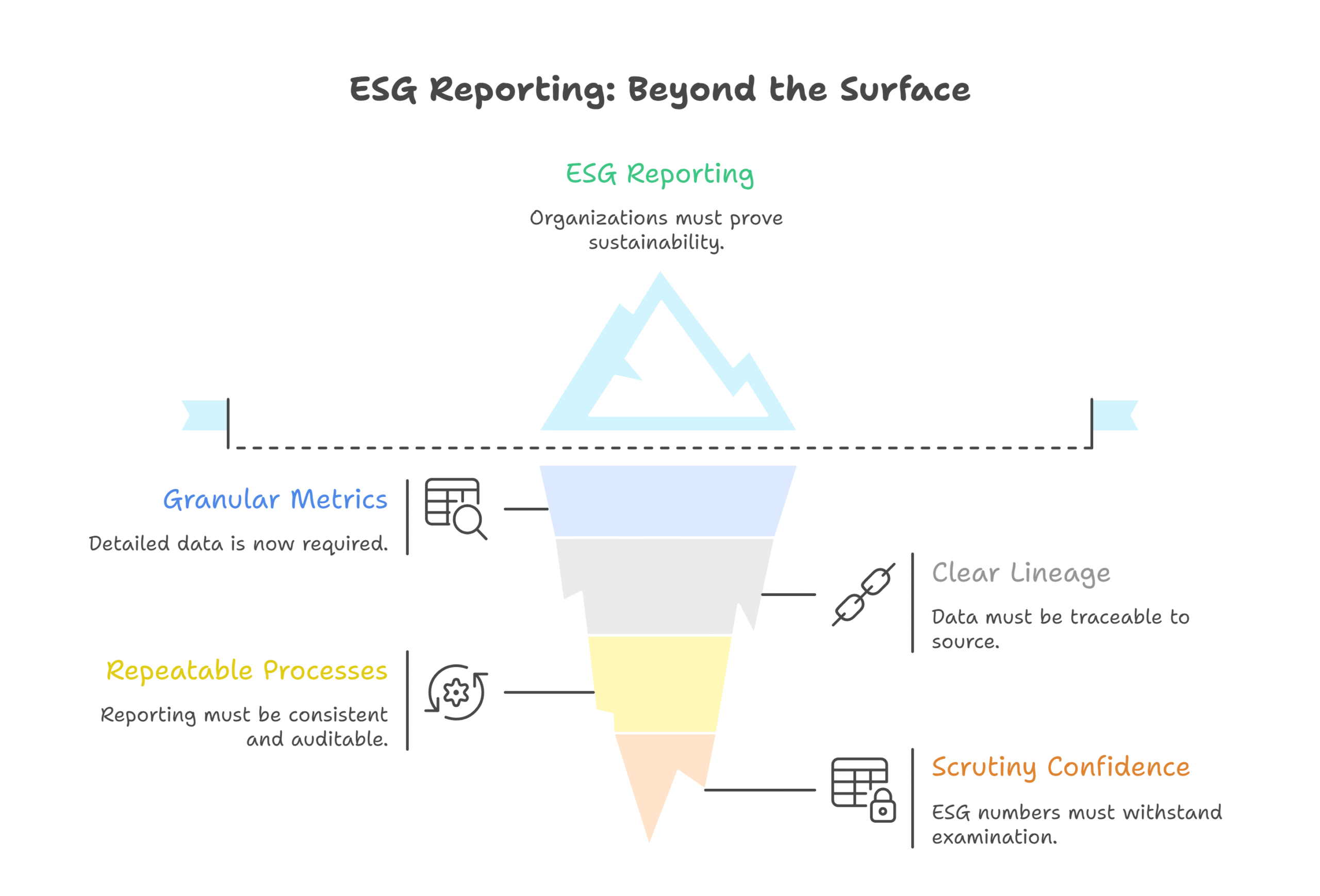
Frameworks such as CSRD, GRI, SASB, and TCFD are raising the bar “demanding”:
- Granular metrics
- Clear lineage to source data
- Repeatable and auditable reporting processes
- Confidence that ESG numbers can withstand scrutiny
What once passed as a sustainability narrative is now expected to stand up as enterprise-grade reporting. And this is where many organizations begin to struggle.
The Hidden Complexity Behind ESG Reporting
On the surface, ESG appears to be a reporting problem.
In reality, it is a deeply distributed data problem.
Environmental metrics live across operational systems.
Social indicators span HR, vendors, and partners.
Governance signals are scattered across finance, risk, and compliance platforms.
Most organizations attempt to bridge this complexity using:
- Manual data collection
- Spreadsheet consolidation
- Periodic validations
- Point-in-time snapshots
This approach works until it doesn’t.
As reporting frequency increases and regulatory expectations tighten, ESG teams find themselves overwhelmed by reconciliation cycles, version mismatches, and explainability gaps. The result is an ESG program that consumes significant effort but delivers limited confidence.
When ESG Becomes a Trust Problem
The real risk is not inefficiency — it is loss of trust.
When leaders cannot confidently answer:
- Where did this number come from?
- Why did it change this quarter?
- What assumptions were applied?
- How would a business decision impact future ESG scores?
ESG reporting shifts from being a strategic asset to a compliance burden.
At this stage, organizations are not failing due to lack of intent — they are constrained by legacy reporting mindsets applied to modern sustainability expectations.
ESG Needs to Evolve Beyond Static Reporting
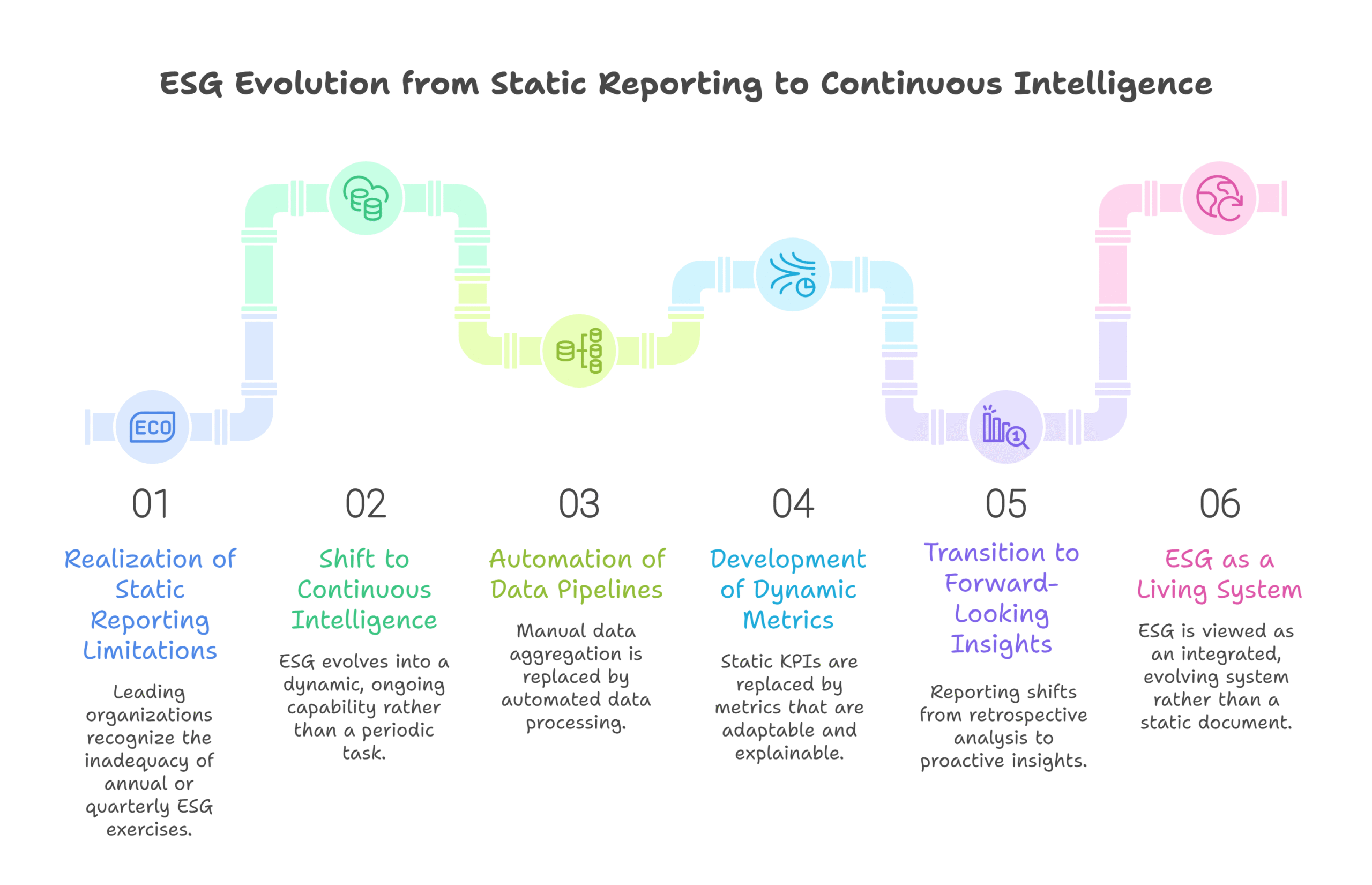
Leading organizations are realizing that ESG cannot remain an annual or quarterly exercise. It must evolve into a continuous intelligence capability.
This requires a fundamental shift:
- From manual aggregation → automated data pipelines
- From static KPIs → dynamic, explainable metrics
- From retrospective reporting → forward-looking insights
In short, ESG must be treated as a living system, not a document.
The Turning Point: ESG as an Intelligent System
Just as AI initiatives stalled when built on brittle data foundations, ESG programs risk plateauing when intelligence is layered on top of fragmented reporting workflows.
To move forward, organizations need ESG platforms that can:
- Discover and contextualize ESG-relevant data automatically
- Apply regulatory logic consistently across regions and frameworks
- Continuously validate, reconcile, and explain metrics
- Support decision-makers with real-time ESG impact analysis
This is no longer achievable through traditional BI or rule-heavy automation alone.
What Comes Next: Agentic AI for ESG Reporting
As ESG expectations continue to rise, organizations will soon realize that traditional reporting models — even when automated — are not enough.
The next phase of ESG will not be defined by more dashboards or more rules. It will be shaped by systems that can reason, adapt, and continuously align sustainability goals with enterprise data and decision-making.
In an upcoming use case, we will explore how an Agentic AI–driven approach can fundamentally change how ESG reporting is generated — moving it from a periodic compliance task to an intelligent, always-on capability embedded into the enterprise.
Stay tuned. The way ESG reporting is built is about to change.
Related Resources:

Modernize Legacy Data Workloads Faster with DBShift™ + Snowflake — Webinar
Watch how DBShift™ automates legacy-to-Snowflake migration with high accuracy—live demo, architecture, and proven outcomes. Ideal next step after this article.

Unified Data with Snowflake & Systech
See how Systech leverages Snowflake’s power to deliver seamless, scalable data solutions.

Snowflake Partnership: Built for the Future
Explore how our Snowflake partnership empowers GenAI-driven transformation journeys.