Medallion architecture is simple. Three layers. Raw data goes in at Bronze. It gets cleaned at Silver. Business-ready at Gold.
That’s the pitch. It’s also where most teams stop — and it’s why their lakehouse quietly turns into a swamp.
Across enterprise Databricks migrations, the same failure pattern shows up again and again. Teams understand Medallion Architecture at a high level, then underestimate the three things that actually make it work: well-defined data contracts, clear ownership, and enforced quality controls. The result? It quickly devolves into a data swamp.
The myth: Medallion is a folder structure
Most teams implement medallion like this:
- Create three containers in Azure Data Lake or S3: /bronze, /silver, /gold
- Write raw data to bronze
- Run some SQL to clean it into silver
- Expose silver to Power BI and call it gold
This is not medallion architecture. This is just three folders with a story.
The real medallion pattern is a set of rules (contracts) — explicit agreements about data quality, ownership, latency, and schema stability at each boundary. Without the rules, the layers are meaningless.
Four contracts do the work: where each business rule lives, what quality has to pass each boundary, who owns each table, and what downstream consumers are promised. Every mistake below is one of those four contracts left unwritten.
Mistake #1: Duplicating business logic across layers
The most common and most damaging mistake. Teams write transformation logic at the Bronze-to-Silver step, then rewrite it again at Silver-to-Gold — often with slight differences, producing metrics that don’t reconcile.
Finance runs a revenue report from Gold. Operations runs the same metric from Silver (because Gold “isn’t ready yet”). The numbers differ by 4%. Nobody knows which is right. Both are wrong.
Every business rule has exactly one definition, in exactly one layer.
The fix
Define each rule in one place only:
- Silver → clean and standardize data (types, nulls, deduplication)
- Gold → apply business logic (KPIs, revenue rules)
Don’t duplicate logic across layers.
Mistake #2: No quality checks between layers
Data moves from Bronze to Silver without any checks. Bad data slips through unnoticed — until it shows up in reports and causes obvious errors (like impossible metrics).
Nothing crosses a layer boundary without passing a declared quality check.
The fix
Add clear quality checks at every layer. If data fails:
- In Bronze → quarantine it
- In Silver → raise an alert
Don’t let bad data pass silently.
Mistake #3: Multiple teams writing to Gold with no schema governance
Gold becomes a free-for-all. The Finance team adds columns. The Operations team renames a field. The Data Science team drops a table they thought was unused. Nobody owns any of it.
Every Gold table has one named owner and one approved path for schema change.
The fix
Every Gold table needs a single domain owner, a schema change approval process, and an SLA. Unity Catalog enforces access. Azure DevOps enforces schema changes via PR review. MERGE INTO with defined keys prevents silent overwrites.
Mistake #4: Treating Silver as the serving layer
Teams build Power BI reports directly on Silver tables because Gold “isn’t ready.” Silver becomes the de facto production serving layer — but it was never designed for that. No semantic model. No performance optimization. No stability guarantees.
Only Gold makes promises to consumers — Silver makes none, by design.
The fix
Gold is not optional. It is the only layer that serves downstream consumers. Silver is internal infrastructure. No BI tool should ever connect to Silver directly.
Correctly Designed Medallion Architecture
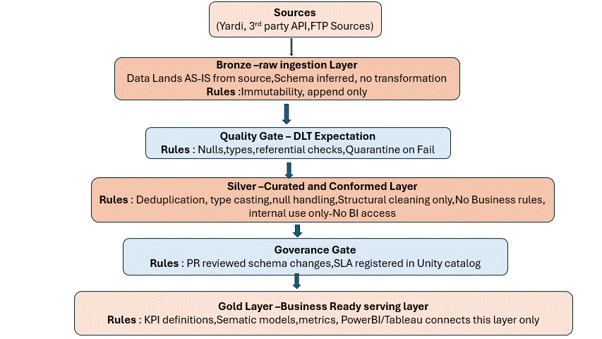
Notice the two main gates. Most teams skip both of them. The DLT expectations gate between Bronze and Silver is what prevents bad data from becoming permanent. The governance gate between Silver and Gold is what prevents Gold from becoming a free-for-all.
Conclusion: Bronze. Silver. Gold.
Simple in concept — but powerful when done right.
- Bronze: Raw data, exactly as received
- Silver: Clean, consistent, and reliable data
- Gold: Trusted, business-ready metrics with clear SLAs
When each layer delivers on its promise, everything changes:
- Reports become reliable.
- Numbers stop conflicting.
- Teams move faster with confidence.
So why do so few teams get there?
Medallion architecture doesn’t fail because of technology. It fails because teams treat these layers as just data storage zones, rather than what they truly are: a system of data contracts.
In simple terms:
- Medallion layers define where data lives
- Contracts define how data behaves and can be trusted
Without those contracts, the architecture doesn’t solve anything — it just organizes the chaos.
Who owns each Gold table? What check has to pass for data to cross each boundary? And what is the consumer promised about freshness and schema stability?
So before you stand up the next set of three containers, answer those three questions. If you can’t, you don’t have a medallion architecture yet.