The Challenge: Insurance Fraud in the Middle East
Insurance fraud costs the global industry over $80 billion annually. For Middle East insurers managing complex multi-line portfolios across motor, health, property, and marine, the challenge is compounded by high claim volumes, multi-jurisdictional regulations, and paper-heavy processes. Investigators drown in spreadsheets, PDFs sit unread in shared drives, and by the time a suspicious pattern surfaces, the money is already gone.
What if fraud investigators could simply ask a question — in plain English or Arabic — and get an instant, data-backed answer drawn from both structured databases and unstructured claim documents?
That is exactly what we built: the Insurance Fraud Investigation Command Center, a production-grade Streamlit application running as a Databricks App, powered entirely by the Databricks Data Intelligence Platform.
The Solution at a Glance
The Command Center is a seven-page analytical application serving fraud investigators, supervisors, and executives:
| Page | What It Does |
|---|---|
| Investigation Pipeline | Real-time view of all investigations by status (Initiated → In Progress → Completed → Closed) and findings classification (Fraud Confirmed, Suspected, Inconclusive, No Fraud) with high-risk case drill-down |
| Trend Analysis | Monthly time-series of fraud amounts detected, recovery rates, investigation costs, and fraud scores with interactive metric selection |
| Investigator Performance | Scoreboard ranking investigators by cases handled, average resolution days, recovery amounts, and ROI per investigator |
| ROI Analysis | Net benefit calculation — total investigation cost vs. total recovery — giving leadership a clear dollar-value justification for the fraud program |
| GenAI Insights | Seven AI-powered sub-tabs including Genie integration, AI summaries, claims document RAG search, a text-to-SQL fraud agent, sentiment analysis, multi-dimensional risk scoring, and ML-powered fraud trend forecasting |
| AI Supervisor | A multi-agent supervisor that orchestrates Genie (structured data across 19 tables) and a Claims Document RAG agent (25 PDFs) to answer complex questions spanning both data sources |
| Observability | Full-stack AI monitoring: token costs in USD from system.billing, RAG agent latency and success rates, endpoint token usage, ai_query performance, and error logs — all with configurable time ranges |
All of this is served through a single Databricks App deployment with no external infrastructure.
Genie: The Game-Changer for Fraud Teams
If there is one capability that transforms how fraud teams operate, it is Databricks AI/BI Genie.
Before Genie, every new question required either a pre-built dashboard (weeks of development) or a SQL-literate analyst (scarce and expensive). With Genie:
- A claims manager asks "What was total fraud detected last month?" at 7 AM before a board meeting — and gets the answer in 10 seconds.
- An investigator asks "Show me all high-risk cases assigned to Investigator 107" — without knowing that this requires joining multiple fact and dimension tables.
- A finance director asks "What is our investigation ROI by business line?" — and Genie writes a four-table join with ROUND and GROUP BY clauses they could never write themselves.
- A fraud investigator asks "ما هي المطالبات عالية المخاطر هذا الشهر؟" (What are the high-risk claims this month?) — and gets the same governed, cited answer in seconds.
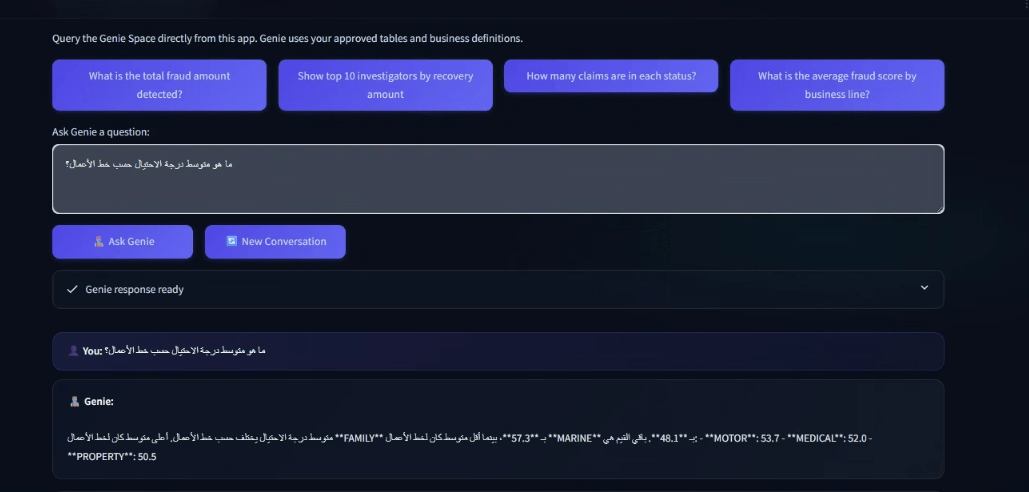
Genie responding to a natural language query in Arabic — same governed SQL engine, same Unity Catalog permissions, zero configuration changes.
Our Genie Space connects to 19 production tables and is embedded directly in the Streamlit app — no context switching, no separate tool. The conversation is stateful, so users can ask follow-up questions in the same thread.
Multi-Agent Supervisor: Structured + Unstructured Intelligence
The AI Supervisor page represents a true compound AI system. When an investigator asks "Investigate claim CLM000089 — show the fraud score, amounts, and what the investigation report says", the supervisor:
- Routes the structured data question to the Genie Space (fraud scores, claim amounts from 19 SQL tables)
- Routes the document question to the Claims RAG Agent (searches 25 parsed PDF claim documents via Vector Search)
- Synthesizes both responses into a single, coherent answer
This is built with Databricks Agent Bricks and served on a serverless model serving endpoint. The user asks one question; two specialized agents collaborate behind the scenes.
This multi-agent architecture is delivered through Systech's AgentBuild™ framework — our production-tested accelerator for designing, deploying, and governing compound AI systems on Databricks. AgentBuild™ handles the orchestration layer, agent role definitions, prompt engineering, and MLflow-backed evaluation so delivery teams can move from use case to production agent in weeks rather than months.
AI Functions Built into SQL
The application leverages Databricks AI Functions (ai_query, ai_analyze_sentiment, ai_classify) directly within SQL:
- Sentiment Analysis:
ai_analyze_sentiment()evaluates investigation outcomes — classifying each case as positive, negative, mixed, or neutral based on financial recovery, fraud scores, and resolution timelines. - Risk Scoring:
ai_classify()performs multi-dimensional risk classification (Severity × Likelihood × Impact) using LLM reasoning, with a rule-based fallback for instant results. - Executive Summaries:
ai_query()calls LLM to generate narrative summaries from portfolio statistics. - Fraud Trend Forecasting: A hybrid statistical model (linear regression + exponential smoothing) generates forecasts with 95% confidence intervals, and then
ai_query()produces an LLM-powered narrative interpretation of the trend.
Every AI function call is measured. The Observability tab tracks latency per row (e.g., ai_analyze_sentiment at ~5s/row, ai_classify at ~10s/row), so teams can make informed choices between AI-enhanced and rule-based modes.
Document Intelligence: From PDF to Insight
Twenty-five claim documents — submission forms, settlement notifications, investigation reports, denial letters — were ingested into a Unity Catalog Volume, parsed using ai_parse_document(), chunked (both flat and hierarchical strategies), embedded with databricks-bge-large-en, and indexed in Vector Search. The RAG agent retrieves relevant chunks and uses LLM to synthesize answers. An investigator can ask "Which claims were denied and why?" and get a grounded, citation-backed answer in seconds.
Full-Stack AI Observability
The Observability page provides production-grade monitoring across the entire AI stack:
- Token Cost ($): Queries
system.billing.usagejoined withsystem.billing.list_pricesto show actual USD costs by endpoint, by SKU, with daily trend charts. During development, the entire AI stack cost single-digit dollars per week. - RAG Agent Performance: Request volume, average/P50/P95 latency, and success rates over time.
- Endpoint Usage: Per-endpoint breakdown of input/output tokens, error counts, and request volumes.
- AI Query Performance: Call volume and duration metrics segmented by agent type (Supervisor, Claims RAG, Sentiment, etc.).
- Error Logs: Unified error feed across all AI components with source attribution.
AgentBuild™ — Reference Architecture
The architecture follows a left-to-right data flow across five layers, unified by the Unity Catalog governance layer at the foundation:
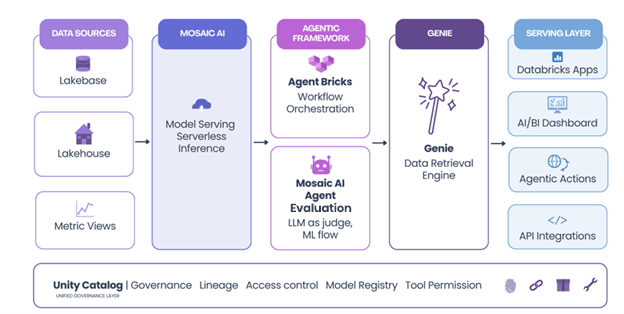
| Layer | Components | Role in Our Solution |
|---|---|---|
| Data Sources | Lakebase, Lakehouse, Metric Views | 19 Delta tables (fraud investigations, claims, customers, policies), parsed claim documents, and AI result tables |
| Mosaic AI | Model Serving, Serverless Inference | Serverless endpoints hosting LLM, BGE-Large-EN embeddings — all with scale-to-zero and pay-per-token economics |
| Agentic Framework | Agent Bricks (Workflow Orchestration), Mosaic AI Agent Evaluation (LLM as judge, MLflow) | Multi-agent supervisor orchestrates Genie + Claims RAG Agent; MLflow evaluators score relevance, safety, and groundedness |
| Genie | Genie — Data Retrieval Engine | Genie Space connected to 19 tables — translates natural language to governed SQL, embedded in the Streamlit app |
| Serving Layer | Databricks Apps, AI/BI Dashboard, Agentic Actions, API Integrations | Streamlit app served as a Databricks App; AI/BI dashboards for executive reporting; API integrations for downstream systems |
Governance: Unity Catalog is the single governance plane for data, models, and agents. Tables carry row-level and column-level policies, models are versioned with schemas, and agent tools are permissioned — no bolt-on security layer needed.
Lineage: Every data path is traced automatically — from Genie queries joining fact and dimension tables to RAG retrievals from Vector Search indexes. Compliance teams can answer "where did this number come from?" without chasing engineers.
Access Control: One permission model governs tables, AI endpoints, Genie Spaces, and system tables. When Genie generates SQL on behalf of a user, it inherits that user's permissions transparently — investigators, supervisors, and finance each see only what they should.
Model Registry & Tool Permissions: Every agent and ML model is registered with version history, evaluation metrics, and deployment lineage. Tool permissions restrict agents to only the functions and endpoints they are authorized to call — preventing scope escalation.
How We Applied GOAT Principles
We designed this application around the GOAT principles — Governed, Open, AI-Native, and lower TCO. Every asset — tables, models, agents, and documents — is governed under Unity Catalog with full lineage, row-level security, and audit tracking; no shadow data exists anywhere. The entire stack is built on open-source technologies (Delta Lake, MLflow, LangChain, Streamlit), meaning we can swap any LLM or UI framework without touching business logic. AI is not an add-on — Genie, multi-agent orchestration, and SQL AI Functions are embedded directly into investigator workflows as the primary interface. Finally, serverless-everything economics (SQL Warehouses, Model Serving, Databricks Apps) with scale-to-zero and real-time billing visibility keep the entire AI stack running at single-digit dollars per week — one platform replacing five.
Results and Impact
| Metric | Before | After |
|---|---|---|
| Time to answer an ad-hoc fraud question | 2-3 days (analyst queue) | 10-30 seconds (Genie or Agent) |
| Document search across claim PDFs | Manual — hours per investigation | RAG-powered — seconds with citations |
| Cost visibility for AI operations | None | Real-time USD breakdown by endpoint |
| Infrastructure components to manage | 5+ separate tools | 1 platform (Databricks) |
| Governance model | Per-tool, inconsistent | Unified via Unity Catalog |
| Vendor lock-in risk | High (proprietary formats) | Low (Delta Lake, MLflow, LangChain) |
Getting Started
The fastest path to value on Databricks is Genie — and Systech has built the delivery framework to get you there without the trial and error.
Start with your data foundation. We begin every engagement with a Unity Catalog Readiness Assessment — mapping your existing tables, business definitions, and governance policies so Genie understands your domain language from day one. No generic setup. No rework later.
Deploy your first Genie Space. We configure your Genie Space against your production tables and embed it directly into your workflow — whether that’s a Databricks App, an AI/BI Dashboard, or your team’s existing collaboration tools. Your business users start asking questions in plain language within days.
Layer in compound intelligence. Once Genie handles structured queries, we orchestrate it alongside RAG agents, document search, and external APIs using our AgentBuild™ framework — building multi-agent systems that answer questions no single tool can. The Fraud Investigation Command Center you just read about is one example of what that looks like in production.
Monitor everything from day one. Every token, every dollar, every query — tracked via system.billing and Unity Catalog audit logs. You always know what your AI stack costs and why.
Genie is the starting point. AgentBuild™ is how you scale it.
Ready to build your first agent? Systech’s AgentBuild™ QuickStart delivers a production-ready Genie-powered agent in four weeks — at no cost. Contact us to claim your QuickStart →
The Fraud Investigation Command Center was built on the Databricks Data Intelligence Platform running on Azure, using Unity Catalog, AI/BI Genie, Mosaic AI Agent Framework, Vector Search, Model Serving, AI Functions, MLflow, and Databricks Apps. The application serves fraud investigators across the Middle East insurance market.
* Client details available on request. To connect with our delivery team or learn more about this engagement, contact marketing@systechusa.com